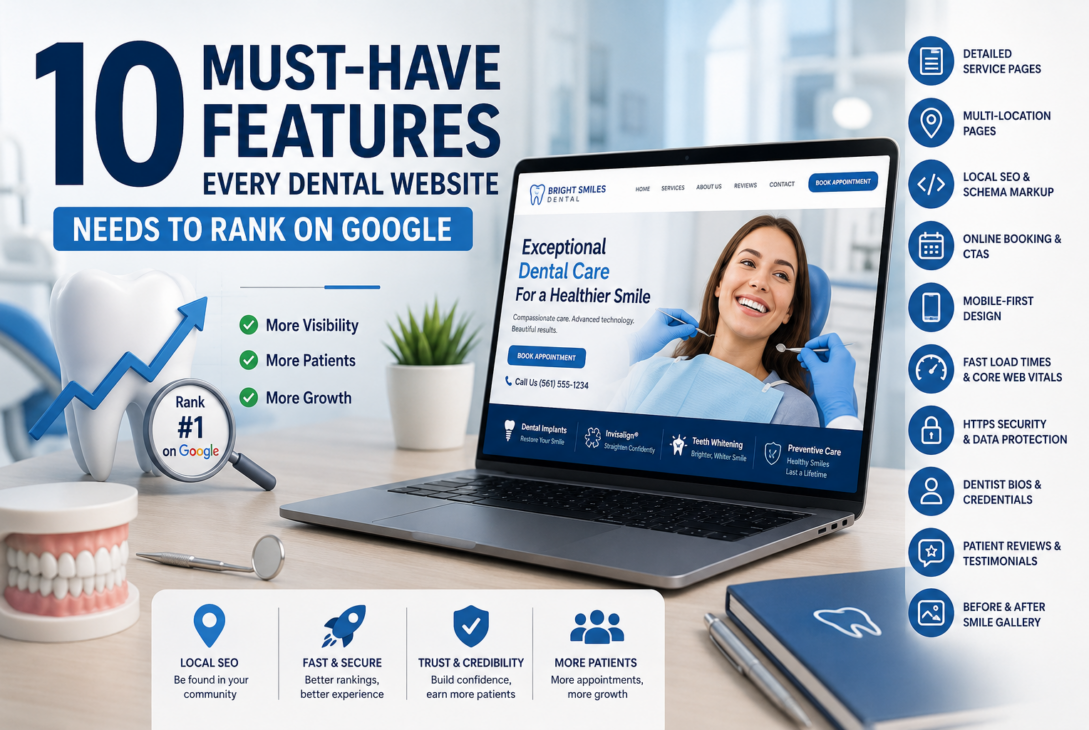
Getting found on Google is no longer optional for dental practices it is essential. With more patients searching online before they ever pick up the phone, your dental website is often the first impression you make. And if it does not show up on the first page of search results, it might as well not exist.
But ranking on Google takes more than just having a website. It requires the right combination of technical SEO, local optimization, and a user experience that keeps visitors engaged. The good news? You do not need to overhaul everything at once. Start with these 10 must-have features and build from there.
1. Dedicated Service Pages
One of the biggest SEO mistakes dental websites make is cramming every treatment onto a single page. Instead, create a separate page for each service you offer, dental implants, teeth whitening, Invisalign, routine cleanings, and so on.
Each page gives you a targeted opportunity to rank for specific local searches like “dental implants in Boca Raton” or “teeth whitening near me.” Google rewards relevance, and dedicated pages send a clear signal about what you offer and where.
2. Multi-Location and Optimized Local Pages
If your practice operates from more than one location, each office deserves its own landing page. Do not copy and paste the same content across locations, Google penalizes duplicate content and rewards uniqueness.
Each location page should include the full Name, Address, and Phone number (NAP), an embedded Google Map, and locally relevant content. This structure significantly improves your visibility in local search results across all your service areas.
3. Google Business Profile and Local Schema Markup
Your dental website and your Google Business Profile need to work together. Claim and verify your profile, keep it updated with accurate hours and services, and link it directly to your website.
Go one step further by adding local Schema.org markup to your site’s code. This structured data tells Google exactly who you are, where you are, and what you do, helping you appear in rich results, map packs, and voice searches. Learn more about Schema markup for healthcare providers.
4. Online Booking and Clear Calls to Action
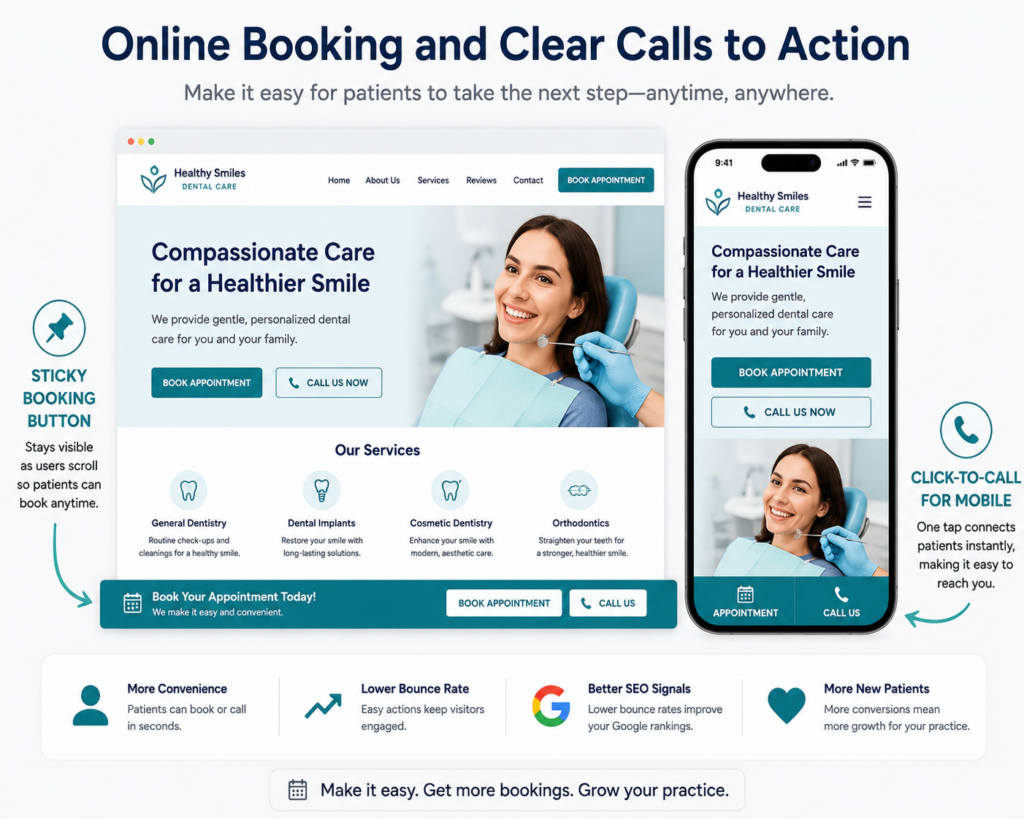
Patients expect convenience. If they cannot book an appointment directly from your website, many will simply move on to a competitor who lets them.
Add a sticky “Book Appointment” button that stays visible as users scroll. Include click-to-call buttons for mobile users. The easier you make it to convert a visitor into a patient, the lower your bounce rate, and lower bounce rates send positive signals to Google’s ranking algorithm.
5. Mobile-First and Responsive Design
Google uses mobile-first indexing, which means it primarily looks at the mobile version of your website when determining your search ranking. If your site is clunky or hard to navigate on a smartphone, your rankings will suffer.
Every element, menus, forms, images, buttons, must adapt automatically to any screen size. Test your site regularly on multiple devices to ensure nothing breaks or distorts. A seamless mobile experience is not just good for SEO; it is what your patients expect.
6. Fast Load Times and Core Web Vitals
Page speed is a confirmed Google ranking factor. If your dental website takes more than 3 seconds to load, a large portion of your visitors will leave before they even see your content.
Compress your images, use a reliable hosting provider, and eliminate unnecessary code. Google measures your performance through Core Web Vitals, metrics that evaluate loading speed, visual stability, and responsiveness. You can check your scores using Google’s PageSpeed Insights tool.
7. HTTPS Encryption and Patient Data Security
Would you trust a healthcare website that is not secure? Neither would your patients, and neither does Google.
Make sure your dental website uses an active SSL certificate (the padlock icon and “https://” in the URL). This protects sensitive patient information and is a basic ranking requirement. If your site handles online forms or patient data, HIPAA-compliant practices are not just good ethics, they are a legal and reputational necessity.
8. Dentist Bios and Staff Credentials
Google’s E-E-A-T guidelines, which stand for Experience, Expertise, Authoritativeness, and Trustworthiness, carry significant weight in how health-related websites are ranked. For dental websites, this means showcasing the real people behind your practice.
Publish detailed bios for every dentist and key staff member. Include education, certifications, years of experience, and any specializations. This builds trust with potential patients and signals to Google that your health content is credible and authoritative.
9. Patient Reviews and Testimonials
Social proof is one of the most powerful conversion tools available to your practice. Embedding genuine patient reviews directly on your homepage and service pages keeps visitors engaged longer, and longer time-on-site improves your ranking signals.
Encourage satisfied patients to leave reviews on Google, then feature the best ones on your website. Written testimonials, star ratings, and even short video reviews all contribute to building the local authority that Google rewards.
10. Before and After Smile Gallery
A dedicated smile gallery does double duty: it showcases your clinical skill and it helps you rank in image search results.
Feature real before-and-after photos from actual patients (with consent), and optimize every image with descriptive alt text that includes your target keywords. For example: “dental implants before and after – [Your City].” This simple step helps your images surface in Google Image Search, driving additional organic traffic to your site.
Final Thoughts
Ranking on Google is not about gaming the algorithm, it is about building a dental website that genuinely serves your patients and earns Google’s trust. Every feature on this list works together: local SEO drives discovery, fast performance keeps visitors engaged, and trust signals convert them into booked appointments.
Start by auditing your current website against this checklist. Identify the gaps, prioritize the fixes, and implement them one step at a time. If you need help building or optimizing your dental website for search, consider working with an experienced dental SEO specialist who understands both the technical and clinical sides of your business.
Your next patient is searching right now. Make sure they find you first.