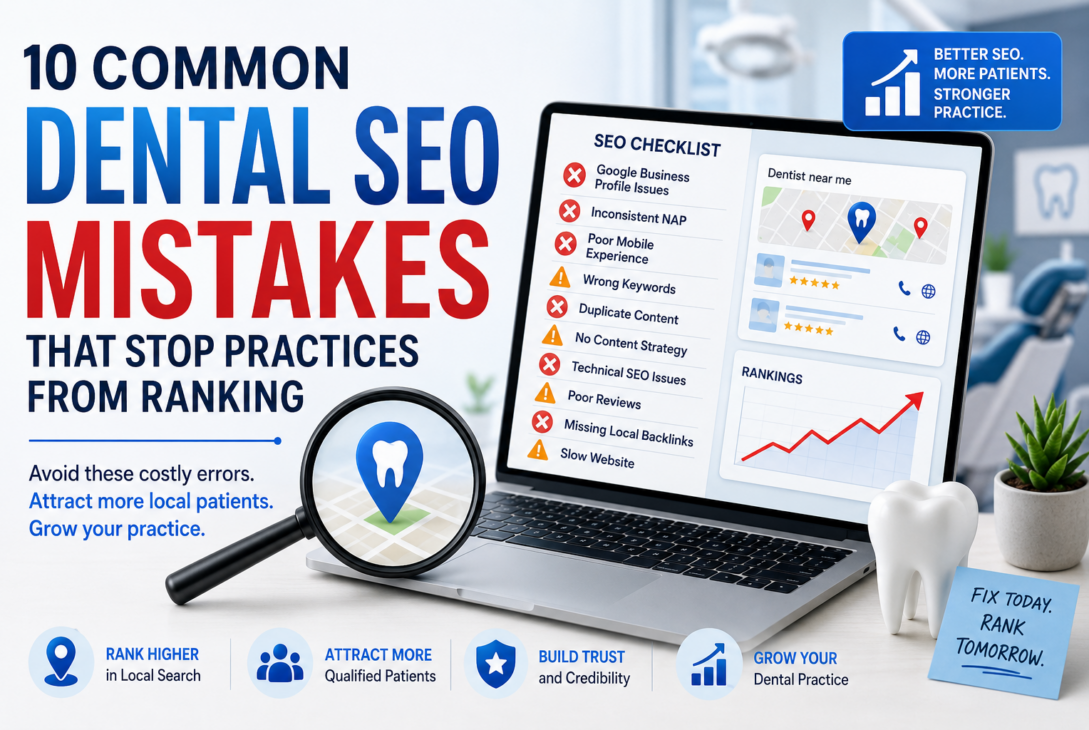
Your dental practice delivers outstanding care, but if patients can’t find you online, your chairs stay empty. In today’s digital-first world, dental SEO (search engine optimization) is no longer optional. It is the engine that drives new patient acquisition, local visibility, and long-term practice growth.
The problem? Most dental websites are quietly sabotaged by a handful of avoidable errors. These mistakes push your practice down the search rankings, right into the arms of your competitors. The good news is that each one is fixable once you know where to look.
Below, we break down the most common dental SEO mistakes and show you exactly how to correct them.
1. Ignoring Local SEO and Your Google Business Profile
Local SEO is the foundation of dental marketing online. When someone searches for a dentist, Google prioritizes practices that are nearby, credible, and well-optimized for local search. The gateway to that visibility is your Google Business Profile (GBP).
An incomplete or unclaimed GBP profile is one of the biggest dental SEO mistakes practices make. Missing business hours, no photos, an outdated address, or zero patient reviews all signal to Google that your listing is unreliable. The result: your practice gets buried, and you miss out on the coveted local “map pack,” the three business listings that appear above organic results.
Fix it: Claim your GBP listing and fill out every section completely. Add high-quality photos of your practice, upload your logo, set accurate business hours (including holidays), and choose the right primary and secondary categories. Aim for your profile to score 100% completion.
2. Inconsistent NAP Data Across Directories
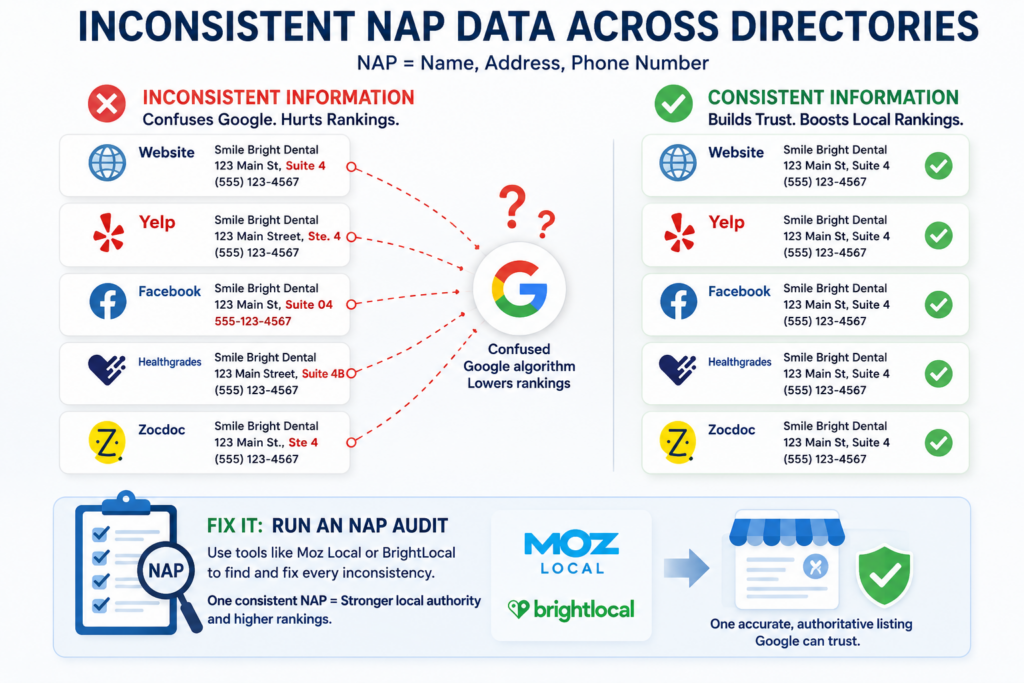
NAP stands for Name, Address, and Phone number. These three pieces of information must be identical everywhere your practice appears online, your website, Yelp, Facebook, Healthgrades, Zocdoc, and every other directory.
Even a small variation, “Suite 4” on one site and “Ste. 4” on another, can confuse Google’s algorithm. It erodes trust, weakens your local authority, and suppresses your rankings. This is one of the most overlooked dental SEO issues because practices rarely audit all their listings.
Fix it: Run an NAP audit using a tool like Moz Local or BrightLocal. Correct every inconsistency across all directories to ensure Google sees a single, authoritative version of your practice.
3. Neglecting Mobile Optimization
More than 60% of local searches happen on mobile devices. If your dental website is slow to load, hard to navigate on a small screen, or forces users to pinch and zoom, they will leave, and Google takes note.
Mobile-unfriendly sites receive lower rankings because Google now uses mobile-first indexing, meaning it crawls and ranks the mobile version of your site above the desktop version. A poor mobile experience does double damage: it hurts your rankings and repels potential patients.
Fix it: Use Google’s PageSpeed Insights to test your site’s mobile performance. Ensure your site loads in under 3 seconds, uses a responsive design, and has large, tappable buttons that make booking an appointment easy on any device.
4. Targeting the Wrong Keywords
Many dental practices chase broad, highly competitive keywords like “dental implants” or “teeth whitening” and wonder why they never rank. These terms are dominated by national brands, large dental groups, and high-authority websites with massive budgets.
The smarter approach is to target local, high-intent keyword phrases that signal a patient is ready to book an appointment. These are sometimes called “hiring intent” keywords, and they convert at a significantly higher rate.
Examples of high-intent dental keywords:
- “Emergency dentist near me”
- “Best dentist in [your city]”
- “Affordable dental implants in [neighborhood]”
- “Family dentist accepting new patients [city].”
Fix it: Use tools like Google Keyword Planner, Ahrefs, or Semrush to identify local, long-tail keywords with realistic ranking potential. Build your service pages and blog content around these terms.
5. Keyword Stuffing
Some practices swing too far in the opposite direction. They pack their website with the same phrase over and over, “dentist Chicago, Chicago dentist, best dentist Chicago,” hoping to trick Google into ranking them higher.
This strategy backfired years ago. Google’s algorithm is sophisticated enough to detect keyword stuffing and will penalize pages that practice it. Beyond the ranking hit, stuffed content reads unnaturally and drives patients away.
Fix it: Write for people first, search engines second. Use your primary keyword naturally in your title, first paragraph, one subheading, and a few times throughout the page. Include related synonyms and phrases to signal relevance without repetition.
6. Using Duplicate or Generic Content
Dental website providers sometimes supply “done-for-you” content that gets replicated across hundreds of dental websites. If your service pages sound exactly like every other practice’s website, Google sees them as duplicate content and ranks none of them well.
Generic content also fails to build trust with patients. A page about “our friendly dental team” that could belong to any practice in the country says nothing meaningful about your specific team, your approach, or your community.
Fix it: Write unique content for every service page. Mention your city, your team members by name, specific procedures you specialize in, and why patients choose your practice. Unique content ranks better and converts better.
7. No Content Marketing Strategy
A website without fresh content tells Google your practice is inactive. Regular blogging and content updates signal that your site is alive, authoritative, and worth surfacing to searchers.
Content marketing is also your best opportunity to rank for informational keywords that attract patients earlier in their decision journey, searches like “how long do dental implants last” or “what to do for a toothache.”
Fix it: Publish at least two to four blog posts per month targeting questions your patients commonly ask. Each post should be well-researched, locally relevant where possible, and optimized for a specific keyword.
8. Overlooking Technical SEO
Technical SEO encompasses the behind-the-scenes elements that help search engines crawl, understand, and index your website. Common technical mistakes include missing HTTPS security certificates, broken links, slow server response times, and a lack of structured data (schema markup).
Schema markup is particularly valuable for dental practices. It helps Google display key information such as your address, hours, reviews, and accepted insurance directly in search results, which increases your click-through rate.
Fix it: Conduct a technical audit using tools like Screaming Frog or Google Search Console. Ensure your site has HTTPS, fix crawl errors, implement LocalBusiness schema markup, and submit your sitemap to Google.
9. Neglecting Online Reviews and Reputation Management
Google reviews are a direct local ranking factor. Practices with more positive, recent reviews outperform those with fewer reviews, even if the latter have a technically superior website.
Beyond rankings, reviews heavily influence whether a prospective patient chooses your practice. Failing to respond to reviews (especially negative ones) signals to potential patients that you are indifferent to their experience.
Fix it: Build a consistent system for requesting reviews after every appointment via text, email, or a QR code at the front desk. Respond to every review professionally and promptly, thanking positive reviewers and addressing concerns from dissatisfied patients.
10. Missing Localized Backlinks
Backlinks, links from other websites pointing to yours, remain one of Google’s most important ranking signals. However, random or low-quality links provide little benefit. What dental practices need most are locally relevant backlinks.
These could come from sponsoring a local charity event, being listed on your city’s Chamber of Commerce website, partnering with a local school for dental health education, or earning a feature in a local news outlet.
Fix it: Actively pursue local link-building opportunities. Reach out to community organizations, join your local business association, and look for sponsorship or partnership opportunities that earn you a legitimate link from a trusted local source.
How to Prioritize Your Dental SEO Improvements
With ten areas to address, it helps to know where to start. Here is a practical action plan:
- Audit your Google Business Profile first. It is free, it is fast, and it directly impacts local pack rankings.
- Fix NAP inconsistencies. Use BrightLocal or Moz Local to find and correct discrepancies.
- Run a mobile speed test. Use Google PageSpeed Insights and fix any critical issues.
- Refresh your keyword strategy. Identify three to five local, high-intent keywords for each core service.
- Plan a content calendar. Commit to publishing consistent blog content optimized for patient questions.
Conclusion: Fix the Fundamentals, Win Local Search
Dental SEO is not about gaming the system; it is about making your practice genuinely easy to find, trustworthy to Google, and compelling to patients. Most dental practices are losing rankings not because of an algorithm mystery, but because of fixable, foundational mistakes.
Start by auditing your Google Business Profile and NAP consistency. Then work through your keyword strategy, content, mobile performance, and technical foundations. Each improvement compounds over time, building lasting visibility in your local market.
If you are ready to stop losing patients to competitors and start dominating local search, a focused dental SEO audit is your first step. Review your site against each point above or work with a dental marketing specialist who can identify and fix every gap on your behalf.
For further reading, explore Google’s official guidance on optimizing your Google Business Profile and Google’s Mobile-Friendly Test tool to benchmark your current performance.