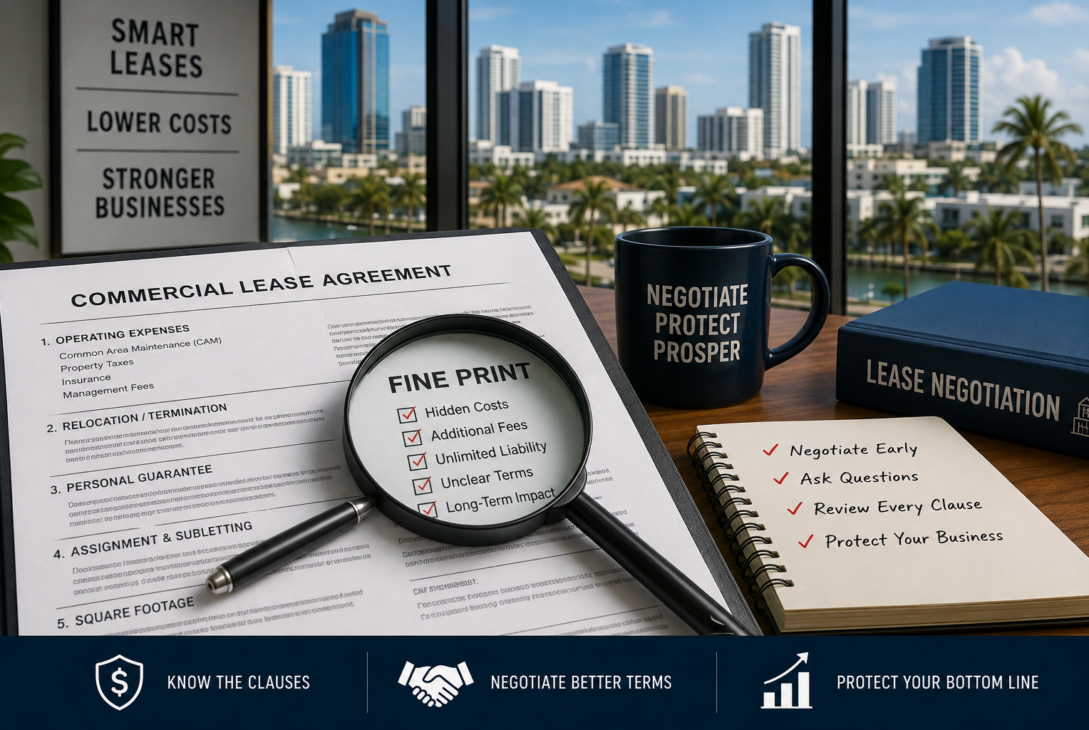
A commercial lease is one of the largest financial commitments a business owner will ever sign. Most tenants focus on the monthly rent, the lease term, and the security deposit, but the most expensive surprises are almost always buried in the fine print.
For any business exploring commercial lease negotiation in South Florida, landlords rarely volunteer; the reality is simple: a commercial lease is not a standard contract. It’s a legally binding agreement filled with clauses that can quietly inflate your operating costs for years. Many of these provisions are negotiable, yet most tenants never review them closely until an unexpected bill lands on their desk months or years later.
Understanding these hidden costs in commercial leases before you sign can protect your cash flow, strengthen your negotiating position, and save your business real money over the life of the lease. Below are five of the most overlooked clauses, why they matter, and how to negotiate better terms.
1. Unlimited Operating Expense Pass-Throughs
Operating expense pass-throughs, often bundled under Common Area Maintenance (CAM), are one of the most common and most overlooked lease provisions. Most commercial leases require tenants to cover a share of building costs such as:
- Property maintenance
- Building insurance
- Landscaping
- Cleaning services
- Property management fees
- Security
- Property taxes
The problem is that many leases place no real limit on how much these charges can grow year over year. Left unchecked, occupancy costs can climb well past the base rent you agreed to at signing.
How to negotiate it: Push for explicit exclusions so landlords can’t pass through costs such as structural repairs, capital improvements, environmental remediation, or expenses that only benefit other tenants. It’s also worth requesting:
- A 3–5% annual cap on controllable operating expenses
- The right to audit annual expense statements
- Itemized breakdowns of every charge billed to you
These protections create transparency and reduce the risk of costs increasing without warning a common complaint from tenants evaluating retail space for lease in South Florida, where CAM charges can vary significantly between properties.
2. Unilateral Relocation or Early Termination Clauses
Some leases give landlords the right to relocate your business to a different part of the property whenever they choose. That sounds minor until you consider how disruptive relocation can be for businesses that depend on visibility, foot traffic, or a custom build-out.
Even more concerning are clauses allowing landlords to terminate the lease early with minimal notice. If you’ve invested in renovations, signage, equipment, or interior fit-outs, a forced move can be financially devastating.
How to negotiate it: Try to eliminate relocation rights. If that’s not possible, negotiate protections such as:
- Six to twelve months’ written notice
- Full reimbursement of relocation costs
- A replacement space of equal or better quality
- The right to terminate if no comparable space is offered
These safeguards keep operational disruption to a minimum if relocation ever becomes necessary.
3. Personal Guarantees and Cross-Default Provisions
Most landlords ask business owners to personally guarantee lease obligations. This is common practice, especially for newer businesses, but a full personal guarantee means your personal assets could be exposed if the business can’t meet its lease obligations.
Cross-default clauses add another layer of risk. These provisions can trigger a default on your commercial lease if you default on an entirely separate agreement with the same landlord, even if you’ve never missed a rent payment.
How to negotiate it: Instead of accepting unlimited liability, ask for:
- A limited (capped) personal guarantee
- A “burn-off” or rolling guarantee that phases out after a track record of on-time payments
- A “good guy” clause that ends your liability once you surrender possession of the space
Also push to remove cross-default language entirely, so each agreement with the landlord stands on its own.
4. Restrictive Assignment and Subletting Clauses
Business needs shift over time. You may eventually relocate, expand, downsize, or sell the business before your lease term ends. Unfortunately, many commercial leases make assigning or subleasing your space difficult.
Some agreements let landlords reject qualified replacement tenants without a valid reason, while others require tenants to hand over any profit earned from subleasing.
How to negotiate it: Make sure the lease specifies that landlord approval:
- Cannot be unreasonably withheld
- Must be provided within a defined, reasonable timeframe
- Is based on clear, objective approval criteria
If market rents rise during your term, negotiate the right to keep some or all of the profit from a sublease rather than forfeiting it to the landlord. Flexibility built in today can pay off significantly down the road.
5. Unclear Square Footage Measurements
Most tenants assume they’re only paying for the space they physically occupy. In practice, commercial leases typically calculate rent based on “rentable” square footage, which can differ meaningfully from the usable space you actually operate in.
Without a recognized measurement standard, you could be paying for far more square footage than you’re actually using, and over a multi-year lease, even a small discrepancy adds up.
How to negotiate it: Require that rentable square footage be measured according to an accepted industry standard (such as BOMA), and add a reconciliation clause allowing rent adjustments if an independent measurement reveals a discrepancy. This ensures you only pay for the space you’re actually leasing.
Why Negotiating Early Creates More Leverage
Timing plays a major role in lease negotiations. As the South Florida commercial real estate market shifts with demand, interest rates, and vacancy levels, landlord flexibility shifts with it. Landlords are typically far more willing to offer favorable terms to tenants who start conversations nine to twelve months before lease expiration, rather than waiting until the final few months.
Starting early gives you room to negotiate:
- Better base rent
- Tenant improvement (TI) allowances
- Flexible renewal options
- Lower operating cost exposure
- More favorable overall lease terms
Waiting too long typically leaves you negotiating from the weakest possible position, and increasingly, business owners are turning to a tenant representation broker Boca Raton companies trust to negotiate on their behalf, since landlords’ leasing agents are ultimately working for the landlord, not the tenant.
Commercial Lease Review Checklist
Before signing, confirm your lease includes:
- Clearly defined operating expense exclusions
- Annual caps on controllable CAM growth
- Audit rights for operating expenses
- No unrestricted landlord relocation rights
- Fair, clearly defined termination provisions
- A limited (not unlimited) personal guarantee
- Removal of unnecessary cross-default clauses
- Reasonable assignment and subletting rights
- Industry-standard space measurement methods
- A rent adjustment clause tied to measurement discrepancies
Reviewing each item carefully now can save you from costly surprises later.
Frequently Asked Questions
Are commercial lease clauses negotiable?
Yes. Unlike many residential leases, commercial leases are highly negotiable. Operating expenses, personal guarantees, renewal options, and assignment rights are all commonly negotiated before signing.
What is a CAM charge?
Common Area Maintenance (CAM) charges are shared building expenses billed to tenants, typically covering cleaning, landscaping, security, insurance, and property management.
What’s the risk of a personal guarantee?
A personal guarantee makes you personally responsible for lease obligations if your business can’t meet them. Depending on how it’s worded, this can put your personal assets at risk even after the business closes.
Should I get a commercial lease reviewed before signing?
Yes. Having a qualified attorney or commercial real estate professional review the lease can uncover hidden risks, clarify complex clauses, and strengthen your negotiating position before you commit to a long-term agreement.
How early should I start negotiating a lease renewal?
Most experts recommend starting nine to twelve months before your lease expires. Earlier conversations typically mean lower costs and more room to negotiate favorable terms.
Protect Your Business Before You Sign
A commercial lease should support your business, not expose it to unforeseen costs. Understanding these five clauses and knowing how to negotiate each one helps you control long-term expenses and avoid disputes down the road.
Every clause in your lease has the potential to affect your bottom line. Reviewing the agreement carefully, getting professional guidance when needed, and negotiating from an informed position are the best ways to protect your business for years to come.