Your dental practice delivers exceptional care. But if patients cannot find you online, that care goes unnoticed. Today, over 77% of patients begin their search for a dentist on Google, and most never scroll past the first page. That means your dental website is not just a digital brochure, it is your most powerful patient acquisition tool.
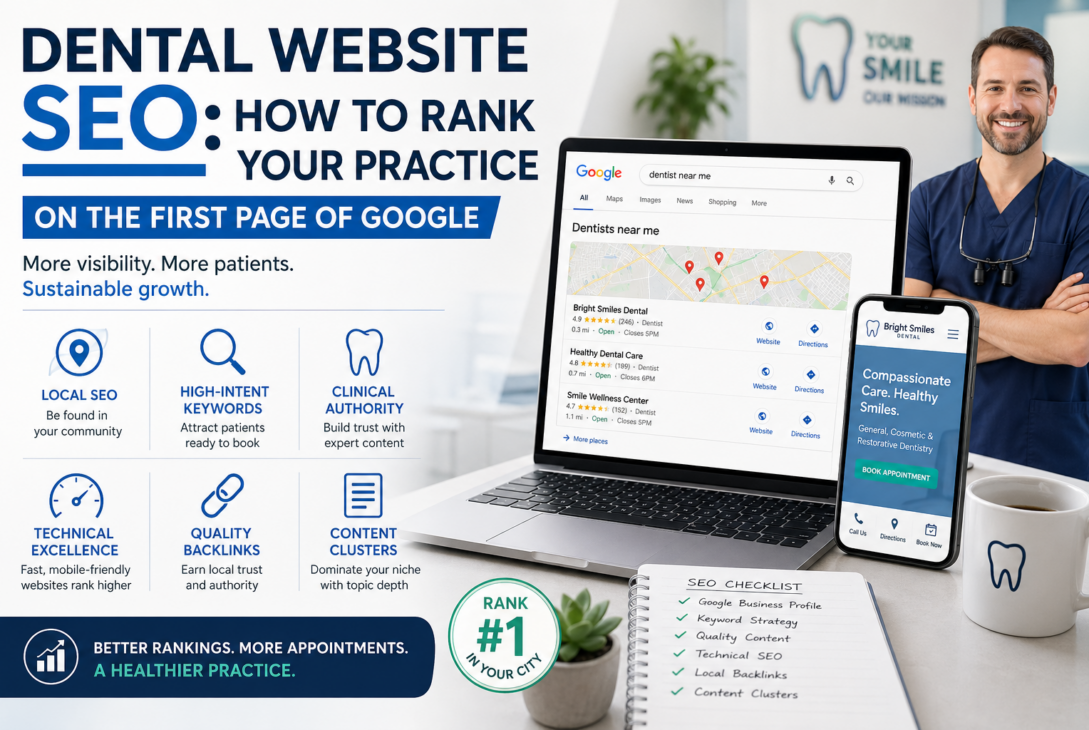
To rank on page one in 2026, you need more than a good-looking site. You need a strategy that combines local SEO, high-intent content, and technical performance. This guide walks you through exactly how to do it.
Why Your Dental Website Needs SEO Now More Than Ever
Search behavior has changed dramatically. Patients no longer ask friends for referrals first, they search Google first. Searches like “dentist near me” or “emergency dental clinic [city]” happen millions of times every day. If your dental website does not appear in those results, a competitor’s site will.
SEO also compounds over time. Unlike paid ads that stop the moment your budget runs out, organic rankings continue to drive traffic month after month. Investing in your dental website’s SEO today builds a long-term patient pipeline at a fraction of the cost of traditional marketing.
1. Master Your Google Business Profile
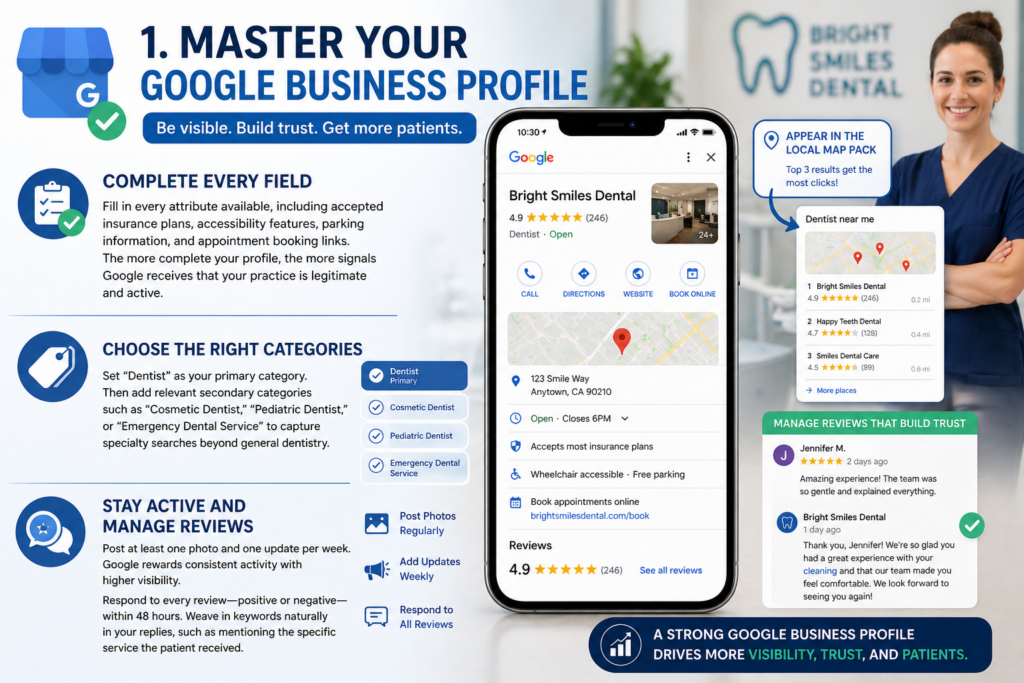
Before a patient ever visits your dental website, they will likely see your Google Business Profile (GBP). This free listing appears in the local “map pack”, the top three results that show up for local searches, and it often drives more clicks than your actual website.
Complete Every Field
Fill in every attribute available, including accepted insurance plans, accessibility features, parking information, and appointment booking links. The more complete your profile, the more signals Google receives that your practice is legitimate and active.
Choose the Right Categories
Set “Dentist” as your primary category. Then add relevant secondary categories such as “Cosmetic Dentist,” “Pediatric Dentist,” or “Emergency Dental Service” to capture specialty searches beyond general dentistry.
Stay Active and Manage Reviews
Post at least one photo and one update per week. Google rewards consistent activity with higher visibility. When it comes to reviews, respond to every one, positive or negative, within 48 hours. Weave in keywords naturally in your replies, such as mentioning the specific service the patient received.
2. Build a High-Intent Keyword Strategy
Generic keywords like “dentist” are too competitive and too broad to convert. High-intent keywords combine a service, a location, and often a sense of urgency. These are the searches that lead directly to booked appointments.
- Emergency terms: “Emergency dentist open now [City]” targets patients who need immediate care and are ready to book.
- Service + cost keywords: “Dental implants [City] cost” or “Invisalign price near me” attract patients actively comparing options.
- Hyperlocal pages: Large dental groups dominate city-wide searches, but you can outrank them by targeting specific neighborhoods. Create dedicated pages such as “Family Dentist in [Neighborhood Name]” to capture highly specific, lower-competition searches.
Use free tools like Google’s Keyword Planner or Ubersuggest to discover what your local patients are actually searching for, then build your dental website content around those exact phrases.
3. Build a Clinical Authority Website
A single “Services” page is no longer enough. Google evaluates dental websites under its “Your Money, Your Life” (YMYL) standards, which means it holds health-related sites to an exceptionally high bar for expertise, authority, and trust (E-E-A-T). Your dental website needs to prove it deserves to rank.
Create Dedicated Service Pages
Give each high-value service its own page with at least 600 words of original, patient-focused content. Pages for dental implants, veneers, teeth whitening, Invisalign, and root canals each need to address what the procedure involves, what patients can expect, and how much it may cost. This depth signals expertise and improves your ranking potential for each individual service keyword.
Demonstrate E-E-A-T on Every Page
Include detailed dentist bios with credentials, associations, and years of experience. Add “medically reviewed” statements where appropriate. Use original photos of your clinic and procedures rather than stock images. These elements collectively tell Google, and your patients, that your dental website is a trustworthy, authoritative source.
Answer Patient Questions with FAQs
Add an FAQ section to each service page addressing common patient concerns: recovery times, pain management, cost ranges, and what insurance covers. This content also positions your dental website to appear in AI-driven search results and voice search responses, which are increasingly prominent in 2026.
4. Get the Technical Foundation Right
More than 70% of dental searches happen on mobile devices. If your dental website is slow, cluttered, or hard to navigate on a smartphone, patients will leave within seconds, and Google will take notice. Technical performance is no longer optional; it is a ranking factor.
- Page speed: Aim for a load time under 2.5 seconds. Use Google PageSpeed Insights to identify uncompressed images, render-blocking scripts, and other issues dragging down your score.
- Mobile-first design: Tap targets (buttons, phone numbers, booking links) should be at least 44px. Forms should support autofill so patients can book an appointment without excessive typing.
- Schema markup: Implement “LocalBusiness” and “Dentist” structured data so Google can clearly read your practice’s name, address, phone number, hours, and services. This improves your chances of appearing in rich search results.
5. Build Local Trust and Earn Quality Backlinks
Google cross-references your dental website against mentions of your practice across the internet. Consistency and local authority are both critical signals for ranking in your area.
Maintain NAP Consistency
Your Name, Address, and Phone number (NAP) must be identical across every platform, your dental website, Google Business Profile, Healthgrades, Zocdoc, Yelp, and any other directory listing. Even minor inconsistencies, like “St.” vs “Street,” can confuse search engines and hurt your local rankings.
Earn Local Backlinks That Actually Count
Backlinks from local sources carry more weight for dental SEO than generic links from unrelated sites. Sponsor a local youth sports team and ask for a link from their website. Partner with nearby businesses, a gym, a school, or a pharmacy, for mutual mentions. Write a guest column for a local news outlet. These geographic signals tell Google that you are a trusted, established part of your community.
6. Use a Content Cluster Strategy to Dominate Your Niche
Rather than publishing isolated blog posts, organize your dental website content into clusters. Choose a core “pillar” page, such as a comprehensive guide to dental implants, and surround it with supporting posts that cover related subtopics: implant costs, implant aftercare, implants vs. dentures, and so on.
Each supporting post links back to the pillar page and to other relevant posts. This internal linking structure distributes authority throughout your dental website and signals to Google that your site covers a topic comprehensively, which is exactly what earns top rankings in 2026.
Your Dental Website Is Your Best Marketing Investment
Ranking on the first page of Google does not happen by accident. It requires a dental website that is technically sound, locally optimized, and rich with content that genuinely serves patients. The good news is that most dental practices are not doing this well, which means the opportunity to stand out is significant.
Start with one high-priority area, your Google Business Profile, one dedicated service page, or a technical audit, and build from there. Consistent, incremental improvements to your dental website will compound into lasting search visibility, more qualified traffic, and a steady stream of new patients.
Ready to take the next step? Conduct a free SEO audit of your dental website today using tools like Google Search Console or Semrush, and identify the quickest wins to start climbing the rankings.