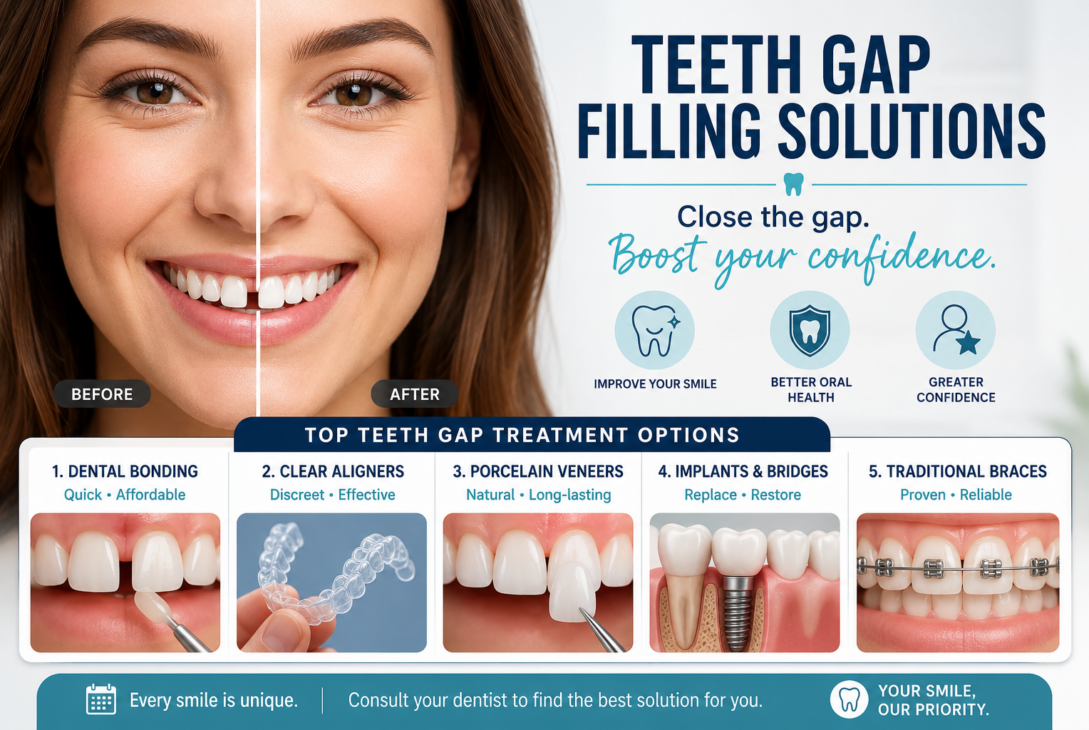
Do you feel self-conscious every time you smile because of a space between your teeth? You are not alone. Many adults and children experience gaps, known medically as diastema. While some people find these gaps charming, others struggle with food getting stuck or feel embarrassed when they laugh or speak.
The good news is that modern dentistry offers a wide variety of teeth gap filling solutions to suit every budget and lifestyle. Whether you have a tiny space in your front teeth or multiple gaps across your smile, there is likely a treatment that works for you.
From painless one-hour bonding to discreet clear aligners, this guide explores the best dental treatments available to help you achieve a seamless, confident smile.
Understanding the Causes of Gaps
Before selecting a treatment, it helps to know why the gap is there. Common causes include a mismatch between the size of your teeth and your jaw bone, missing teeth, or habits like thumb sucking. Additionally, the tissue that attaches the lip to the gum (labial frenum) can sometimes grow too large, pushing the front teeth apart.
Understanding the root cause is essential because some gaps require orthodontic movement, while others simply need cosmetic resizing.
1. Dental Bonding: The Quick Fix for Small Gaps
Best for: Minor, small gaps and chipped edges.
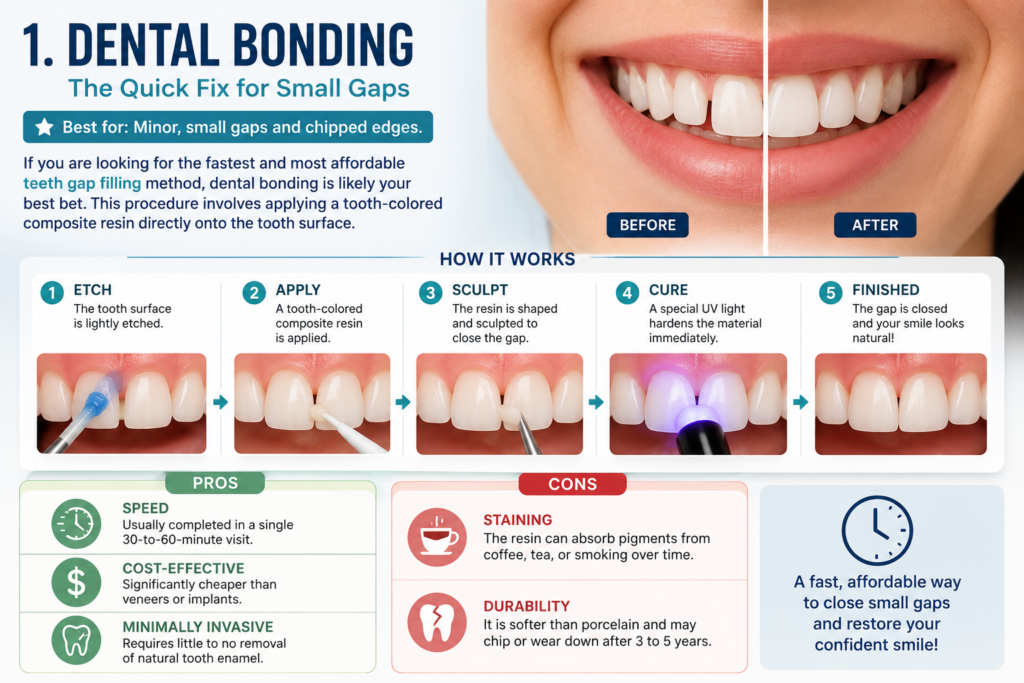
If you are looking for the fastest and most affordable teeth gap filling method, dental bonding is likely your best bet. This procedure involves applying a tooth-colored composite resin directly onto the tooth surface.
How it works: Your dentist will lightly etch the tooth surface, apply the putty-like resin, and sculpt it to close the space. A special UV light hardens the material immediately.
Pros:
- Speed: Usually completed in a single 30-to-60-minute visit.
- Cost-effective: It is significantly cheaper than veneers or implants.
- Minimally invasive: Requires little to no removal of natural tooth enamel.
Cons:
- Staining: The resin can absorb pigments from coffee, tea, or smoking over time.
- Durability: It is softer than porcelain and may chip or wear down after 3 to 5 years.
2. Clear Aligners: Discreet Movement for Larger Gaps
Best for: Moderate to large gaps, multiple gaps, and general alignment issues.
For those who want to move their teeth naturally without metal wires, clear aligners like Invisalign are a revolutionary option. Since they are removable and nearly invisible, they fit perfectly into a professional or busy lifestyle.
How it works: You wear a series of custom-made plastic trays. Each set applies gentle pressure to shift your teeth closer together. Depending on the size of the gap, treatment can take as little as 3 months for tiny spaces to 18 months for larger gaps.
Pros:
- Discreet: Virtually invisible, allowing you to smile confidently during treatment.
- Removable: You can eat, brush, and floss normally.
- Comprehensive: Closes gaps while fixing the bite and crowding.
Cons:
- Discipline required: You must wear the trays for 20 to 22 hours a day.
- Timeline: Requires patience, as results take months rather than minutes.
3. Porcelain Veneers: The Celebrity Smile Makeover
Best for: Gaps accompanied by discolored, misshapen, or worn-down teeth.
If you want to fix multiple cosmetic issues at once—such as a gap, stains, and a chipped tooth—porcelain veneers are the gold standard. These thin shells cover the front surface of the teeth to create a flawless, uniform look.
How it works: The dentist removes a tiny amount of enamel (about 0.5mm) from the tooth surface, takes an impression, and bonds a custom porcelain shell to the tooth.
Pros:
- Aesthetics: Porcelain mimics the light-reflecting properties of natural enamel better than any other material.
- Stain Resistance: Unlike bonding, veneers will not stain from coffee or wine.
- Longevity: With good care, they last 10 to 15 years.
Cons:
- Irreversible: The removal of enamel means you will always need a covering on that tooth.
- Cost: This is one of the more expensive options.
4. Implants and Bridges: Replacing Missing Teeth
Best for: Gaps caused by a missing tooth.
Sometimes a gap exists because a tooth was extracted and never replaced. In these cases, moving the remaining teeth via braces might not be the best solution. Instead, you need to fill the empty space structurally.
Options:
- Dental Implants: A titanium post is surgically placed into the jawbone to act as a new root, topped with a crown. This is the most durable option for teeth gap filling when a tooth is missing.
- Fixed Bridges: The dentist creates a crown for the teeth on either side of the gap, with a false tooth in between to “bridge” the space.
Pros: Restores full chewing function and prevents the surrounding teeth from drifting into the empty space.
Cons: Implants require surgery and several months of healing, while bridges require shaving down healthy adjacent teeth.
5. Traditional Braces: The Heavy-Duty Solution
Best for: Severe bite misalignment and very large gaps.
For complex dental cases where the jaw structure is severely misaligned, traditional metal or ceramic braces remain the most effective tool.
Pros: Highly predictable results for even the most severe gaps. They are often more cost-effective than aligners for complex cases.
Cons: The most visible option, and they can cause discomfort with wires and brackets.
Which Teeth Gap Filling Option is Right for You?
Choosing the right treatment depends entirely on your specific situation. Ask yourself these three questions:
- How big is the gap? Small gaps (<1mm) are great for bonding. Medium gaps (2-4mm) are perfect for aligners or veneers. Missing teeth need implants or bridges.
- Do you want instant results? If you need a new smile for a wedding next week, choose bonding or veneers.
- What is your budget? Bonding is the most affordable upfront, while aligners and veneers are higher investments that provide longer-term value.
If you have a large gap due to a missing tooth, moving the remaining teeth into that space with orthodontics might be possible, but often a dental bridge is the recommended route.
Conclusion
Closing the spaces between your teeth is more than just a cosmetic upgrade. It can improve your oral hygiene by eliminating traps for food debris and help prevent gum disease. Whether you opt for the affordability of composite bonding, the longevity of porcelain veneers, or the medical precision of clear aligners, there is a teeth gap filling solution waiting for you.