
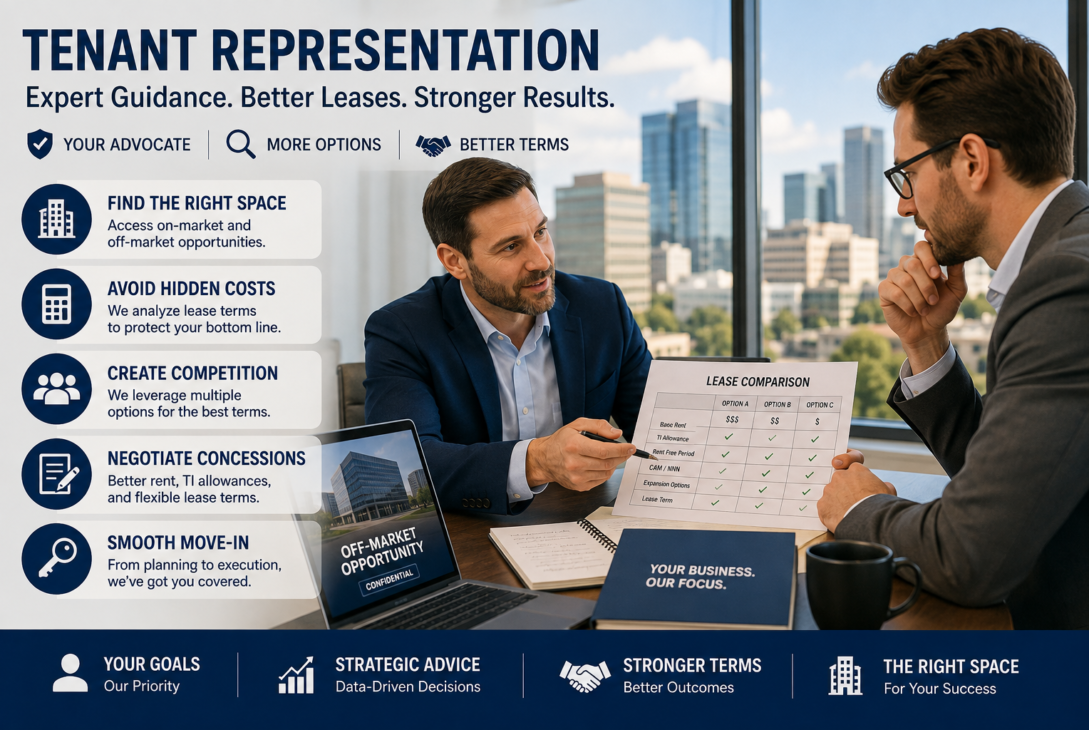
Tenant representation is one of the most critical safeguards a growing company can utilize when securing real estate. Navigating the commercial market without professional guidance often leaves business owners at a distinct disadvantage.
Understanding how tenant representation works allows you to level the playing field, protect your bottom line, and secure the ideal location for your operations.
What Is Tenant Representation?
Tenant representation is a specialized commercial real estate service where a dedicated broker or advisor works exclusively on behalf of a business to find, evaluate, and lease commercial property.
Unlike traditional listing agents who are legally bound to protect the landlord’s bottom line, a tenant rep broker acts strictly as your advocate. Their sole fiduciary duty is to ensure your business’s operational and financial interests come first.
Fiduciary Duty: Landlord Broker vs. Tenant Representative
| Feature | Landlord / Listing Agent | Tenant Representation Broker |
| Primary Client | Property owner / Landlord | Tenant / Your business |
| Legal Loyalty | Maximize rental rates and property profit | Minimize tenant costs and lease risks |
| Market Scope | Promotes only their listed properties | Searches all on-market and off-market options |
| Negotiation Focus | Favorable terms for the landlord | Maximum concessions and flexibility for the tenant |
How a Tenant Rep Broker Helps Your Business
Engaging a commercial real estate broker who specializes in tenant advocacy streamlines an otherwise complex and time-consuming process. They serve as strategic partners throughout every phase of securing a new space.
Defining Needs and Site Selection
Advisors conduct comprehensive assessments to calculate necessary square footage, analyze growth projections, and outline layout requirements. They then guide your site selection strategy to match demographic data, foot traffic, or logistical needs.
Accessing Off-Market Spaces
Public listing portals only display a fraction of available properties. An experienced tenant representation broker uses industry networks to surface off-market spaces and incoming vacancies before competitors see them.
Whether you need an office space for lease, a high-visibility retail space for lease, or an industrial warehouse space for lease, an advisor expands your available options.
Uncovering Hidden Lease Costs
Commercial leases are packed with complex metrics like Triple Net (NNN) charges, Common Area Maintenance (CAM) reconciliations, and annual rent escalations. A representative audits these clauses to prevent unexpected overhead costs.
Creating Landlord Competition
By managing formal requests for proposals (RFPs) across multiple properties simultaneously, your rep forces landlords to compete for your tenancy, driving down pricing and improving terms.
Negotiating Concessions
During commercial lease negotiation, reps actively secure key financial concessions. These include Tenant Improvement (TI) allowances for buildouts, rent-free occupancy periods, and flexible lease renewal or expansion options.
The Commercial Leasing Process
A structured commercial tenant representation partnership follows five key operational phases to take your business from an initial search to occupying a new property.
1.Needs Assessment:Define scope & constraints.
Clarify financial goals, operating budget, size requirements, spatial layouts, and location parameters.
2.Market Selection & Property Tours:Identify target properties.
Evaluate both on-market and off-market opportunities, then conduct targeted physical tours of shortlisted sites.
3.RFPs & Landlord Competition:Build negotiation leverage.
Submit simultaneous Requests for Proposals to multiple property owners to create competitive bidding pressure.
4.Commercial Lease Negotiation:Finalize legal & financial terms.
Refine base rental rates, TI allowances, CAM terms, assignment rights, and expansion clauses.
5.Move-In & Vendor Transitions:Execute space occupancy.
Coordinate final walk-through inspections, contractor buildouts, and operational utility transitions.
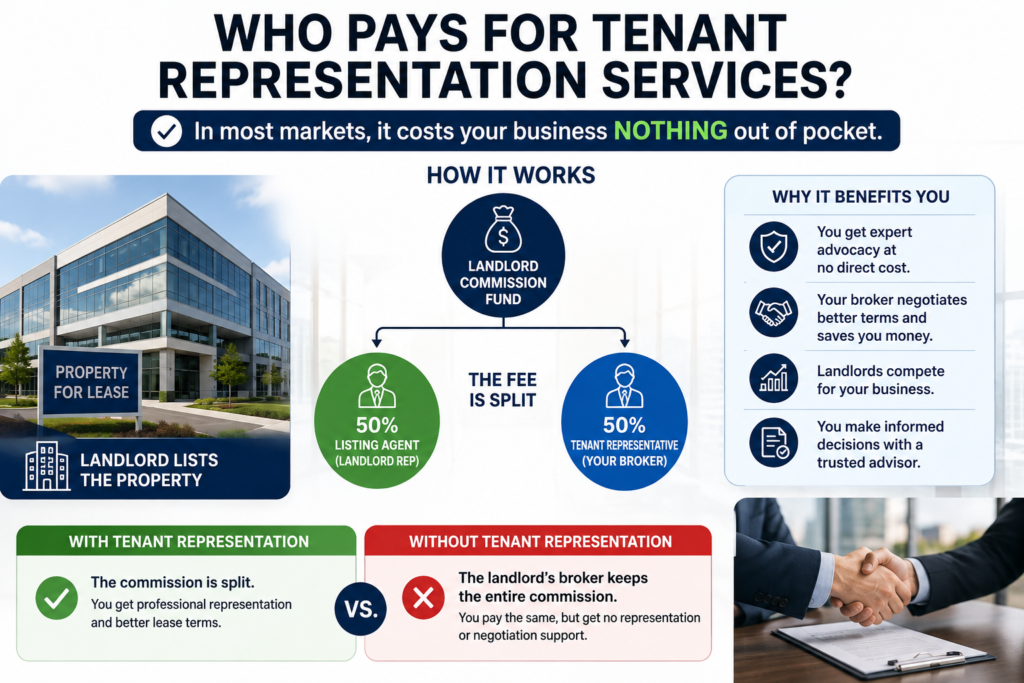
Who Pays for Tenant Representation Services?
In most traditional commercial real estate markets, tenant representation services cost your business nothing out of pocket.
Landlords pre-allocate a commission fee when listing a property. When you hire a tenant rep broker, that fee is split between the listing agent and your representative. If you navigate the market unrepresented, the landlord’s broker keeps the entire fee, while you lose expert guidance during negotiations.
[ Landlord Commission Fund ]
            │
            ├──► 50% ──► Listing Agent (Landlord Rep)
            │
            └──► 50% ──► Tenant Representative (Your Broker)
Finding the Right Commercial Space for Your Business
Securing the right commercial property is a long-term commitment that directly impacts your business’s revenue and productivity. Partnering with a skilled advisor ensures you do not overpay or accept unfavorable terms.
To explore local options, research specialized corporate real estate firms like Newmark Commercial Real Estate, Cresa or leverage brokerage matching platforms like TenantBase to connect with vetted representatives in your submarket.